All published articles of this journal are available on ScienceDirect.

Feasibility of Physiological Assessments for Long-Distance Swimming Safety in Open Water Using Virtual Reality Settings
 iD
iD
Authors Info & Affiliations
Abstract
Introduction
Approximately 240,000 people drown annually worldwide. The benefits of programs of long-distance swimming in the sea are important for children. However, due to safety concerns, fewer schools are implementing the programs. A better system for monitoring heart rate that enables the detection of physiological abnormalities and improves the safety of long-distance swimming is needed. In this feasibility study, a system was developed for an open-water setting. Furthermore, we explored acute stress responses using Virtual Reality (VR) as a potential screening tool.
Methods
40 healthy subjects (28 males, 12 females; age: 18 ± 0.4 years) were timed in the 400m breaststroke, and their peak oxygen uptake (peak VO2) was measured; heart rate was monitored during long-distance swimming in the sea. Furthermore, cardiac autonomic nerve activity was measured during swimming VR exposure.
Results
A significant correlation was observed between heart rate during long-distance swimming in the sea and the 400m breaststroke time (r = 0.46, p < 0.01), but not at peak VO2 (r = -0.10, n.s.). A rapid increase in a subject's heart rate was observed immediately before fitting the buoyancy device. Sympathetic activity after VR exposure was significantly higher than before exposure (p < 0.05).
Discussion
Heart rate during long-distance swimming depends on swimming ability, not maximum aerobic fitness. Monitoring early heart rate spikes could assist in detecting physiological abnormalities. Furthermore, acute stress responses during VR exposure offer a safe screening method for collecting near-miss data in simulated environments.
Conclusion
Real-time heart rate monitoring showed a relationship between swimming ability and heart rate in the sea. The swimming VR exposure demonstrated potential as an exploratory method for safe risk assessment, though its clinical value requires further validation.
1. INTRODUCTION
Approximately 240,000 people drown annually worldwide, and drowning is the third leading cause of unintentional accidental deaths [1]. Additionally, drowning is also one of the prime causes of death among children and adolescents [2]. The World Health Organization (WHO) has also recognized drowning as a problem, and in its first-ever report on drowning, the WHO lists “Ten actions to prevent drowning” as causes and countermeasures for water-related accidents [2]. Also, in Europe, the importance of Water Competency, the qualities and abilities necessary for safe activities in and around water, has been demonstrated [3, 4]. In Japan, the benefits of water education, such as long-distance swimming, are important for children [5]. However, due to safety concerns, fewer schools are implementing such programs.
Meta-analysis results on the outcomes of drowning accidents have shown the critical importance of rapid rescue, such as short-term submersion (less than 5 min) and short Emergency Medical Service (EMS) (less than 9 min) [6]. Accordingly, submersion time appears to be the most important predictor in the evaluation of drowning prognosis [6-10]. This emphasizes the importance of prevention and early reaction in the drowning process [11].
During the initial stages of drowning, sudden cold-water immersion and panic often trigger a prominent physiological response known as hyperventilation [12]. This Hyperventilation may cause fluctuations in heart rate and muscle stiffness. As such, measuring and monitoring heart rate could help to detect physiological abnormalities, and potentially improve the safety of water education. Recently, advancements in wearable technology have enabled the continuous remote monitoring of heart rate and Heart Rate Variability (HRV), providing crucial physiological markers for evaluating acute stress and early signs of physical abnormalities [13, 14].
The aim of this feasibility study was to explore physiological responses during distance swimming and simulated environments: 1) to investigate the feasibility of a real-time heart rate monitoring system in an open water setting, and 2) to explore acute stress responses using a Virtual Reality (VR) video as a potential screening tool.
2. MATERIALS AND METHODS
2.1. Study 1: Real-time Heart Rate Monitoring in the Sea
This prospective simulation study was conducted at Kitaura Beach, Japan, under calm sea conditions (wave height < 0.5 m, sea temperature 28.5 °C) [August 2022]. Participants included 40 undergraduate students specializing in health and sports science (age: 18 ± 0.4 years). The inclusion criteria for the participants were healthy undergraduate students specializing in health and sports science who were enrolled in the regular university swimming training course. The exclusion criteria included individuals with a history of cardiovascular abnormalities, respiratory diseases, orthopedic injuries, or any other medical or physical conditions that would preclude safe participation in long-distance open-water swimming. This study was conducted as part of a regular university swimming training course. Rather than using absolute time thresholds, subjects were categorized into five practical training groups based on their 400 m breaststroke times, while taking into account the overall proportion of students and gender balance in each group (Table 1). Peak oxygen uptake (VO2 peak) was measured using a bicycle ergometer at Kawasaki Medical School Hospital four months prior to the sea swim. Heart rate was monitored during a three-hour long-distance swim. To ensure participant safety, a comprehensive safety management protocol was implemented. The rescue fleet consisted of four outboard motorboats, one jet ski, and four rowboats. A medical doctor was stationed on board one of the motorboats, while a paramedic and a nurse were on standby at the beach base. The criteria for terminating the swim were based on either a voluntary request from the participant or an on-site judgment by the staff, including the medical doctor.
| - | Male | Female | Body Weight (kg) | Body Fat (%) | VO2 Peak (ml/kg/min.) | 400m Time (min' sec”) |
|---|---|---|---|---|---|---|
| Group 1 (n=12) | 9 | 3 | 62.3 ± 6.3 | 19.5 ± 9.5 | 47.1 ± 9.5 | 7'42” ± 1'08” |
| Group 2 (n=10) | 8 | 2 | 64.6 ± 7.6 | 16.8 ± 5.2 | 46.8 ± 8.2 | 10'03” ± 0'25” |
| Group 3 (n= 7) | 4 | 3 | 59.6 ± 9.1 | 17.1 ± 6.9 | 49.7 ± 9.2 | 11'45” ± 0'45” a |
| Group 4 (n= 6) | 3 | 3 | 58.3 ± 4.7 | 21.3 ± 8.2 | 43.9 ± 7.3 | 15'21” ± 2'21” b |
| Group 5 (n= 5) | 4 | 1 | 66.5 ± 11.8 | 12.6 ± 5.0 | 51.9 ± 4.8 | 14'31” ± 1'20” a,b |
Note: * Data were expressed as the mean ± SD. Data marked with different superscripts showed significant differences (p < 0.05) according to the posthoc analysis using Kruskal-Wallis.
2.2. Study 2: Swimming VR Exposure Activity
Sixty-six healthy undergraduate students specializing in health and sports science participated in this study (44 males, 22 females; age: 18.1 ± 0.4 years). To simulate the physical sensation of swimming, subjects immersed their legs in water (30 °C) while being exposed to a VR of swimming off the coast using a head-mounted display (Meta Quest Pro). Measurements were taken during a 2-minute baseline period and a 2-minute VR exposure period. State anxiety was assessed using the State-Trait Anxiety Inventory (STAI) [15, 16] before and after the exposure.
2.3. Ethical Considerations
Both Study 1 and Study 2 were approved by the Institutional Ethics Committee of Kawasaki University of Medical Welfare (Approval No. 23-046) and conformed to the Declaration of Helsinki. Informed consent was obtained from all participants via an opt-out method, which was deemed appropriate because the data were collected as part of a regular university curriculum (swimming training course); information was publicly disclosed, and participants were given the opportunity to decline the use of their data.
2.4. Statistical Analysis
Statistical calculations were performed using R (ver. 4.2.2) and RStudio. A two-way Analysis of Variance (ANOVA) followed by post-hoc Bonferroni tests was used for group comparisons. The relationship between swimming times and heart rate was analyzed using Pearson correlation coefficients. For VR data, paired T-tests or Wilcoxon rank-sum tests were used after normality confirmation. A p-value < 0.05 was considered significant.
3. EXPERIMENTAL SECTION
3.1. Real-time Monitoring System Architecture
A dedicated monitoring system was developed to ensure safety during long-distance swimming. The technical setup involved:
- Sensor Acquisition: Heart rate data was captured using a Polar Verity Sense sensor (Polar Electro, Kempele, Finland) positioned on the participant's temporal area.
- Data Transmission: Data was transmitted to a tablet PC on a monitoring boat following the swimmers.
- Base Station: The tablet relayed real-time data to a base station PC on the beach, allowing medical personnel to monitor physiological changes continuously.
3.2. Theoretical Calculation of Heart Rate Variability (HRV)
Autonomic nervous system activity was quantified using the MemCalc method [17]. The following frequency-domain indices were calculated from the HRV data:
- High Frequency (HF): 0.15 to 0.4 Hz, representing parasympathetic activity.
- Low Frequency (LF): 0.04 to 0.15 Hz.
- Normalization: For statistical validity, frequency components underwent natural logarithmic transformation (lnLF and lnHF).
- Sympathetic Index: The ratio of lnLF/lnHF was utilized as the primary index for sympathetic nerve activity.
4. RESULTS
4.1. Study 1: Real-time Heart Rate Monitoring in the Sea
The actual long-distance swimming time was 2 hours and 52 minutes (Fig. 1).
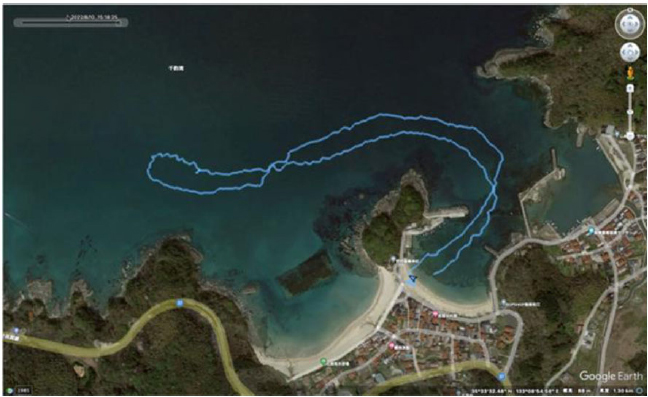
Course map of long-distance swimming. The blue line and markers on the map indicate the actual swimming trajectory of the subjects.
The change in heart rate during long-distance swimming was significantly different between groups (p < 0.001, Fig. 2).
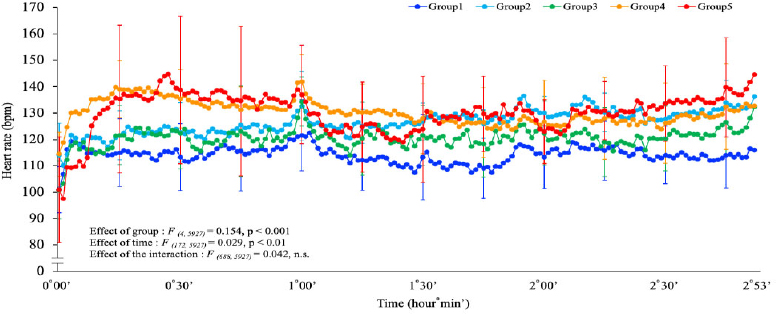
Changes in absolute heart rate for each group during long-distance swimming. Data are shown as means. Error bars represent the 95% confidence intervals (CI), displayed at 15-minute intervals.
There was no significant correlation between the 400m breaststroke time and VO2 peak: estimated maximal oxygen uptake (r = -0.10, N.S., Fig. 3A). There was a significant positive correlation between mean heart rate (p < 0.01, Fig. 3B) and maximum heart rate (p < 0.05, Fig. 3C) during distance swimming and the 400 m breaststroke time.
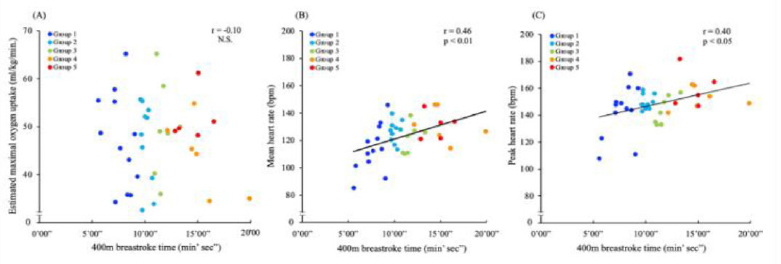
Relationship between estimated maximal oxygen uptake (A), mean absolute heart rate (B), and peak absolute heart rate (C) during long-distance swimming, and the 400m breaststroke record.
Two specific cases requiring rescue support were systematically analyzed (Table 2, Fig. 4). Subject A retired at 1 hour and 31 minutes. As shown in Figure 4A, this subject exhibited a rapid heart rate increase to approximately 175 bpm around 10 minutes into the swim, sustaining this high rate for an hour before dropping out. Following rescue via jet ski, their heart rate decreased to approximately 80-100 bpm over 30 minutes. In another case, Subject B experienced hyperventilation, with their heart rate rapidly spiking from around 140 bpm to 170 bpm at approximately 10 minutes (Fig. 4B). Staff immediately intervened by handing the subject a rescue tube, which resulted in a rapid heart rate recovery to approximately 140 bpm within 1 to 2 minutes.
| Subject | Baseline HR | Timing of HR Spike | Peak HR | Observed Symptoms | Intervention | Recovery Profile |
|---|---|---|---|---|---|---|
| Subject A | ~90 bpm | At approx. 10 min | ~175 bpm | Exhaustion (retired at 1h 31min) | Rescued by jet ski | HR decreased to ~80-100 bpm over approx. 30 min |
| Subject B | ~80 bpm | At approx. 10 min | ~170 bpm | Hyperventilation | Handed a rescue tube | HR rapidly recovered to ~140 bpm within 1-2 min |
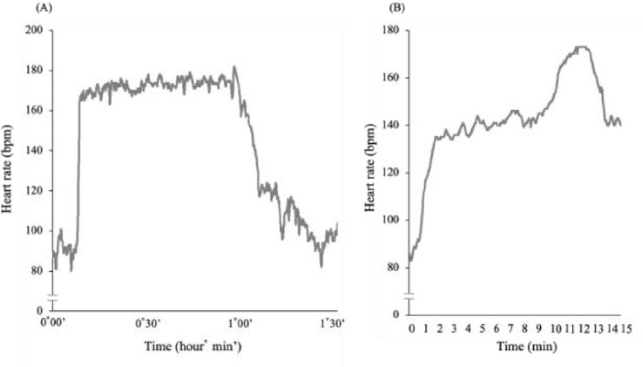
Changes in absolute heart rate during long-distance swimming for two specific cases. (A) Heart rate trajectory of Subject A, who retired at 1 hour and 31 minutes. (B) Rapid heart rate increase observed in Subject B, who required support due to hyperventilation
4.2. Study 2: Cardiac Autonomic Nerve Activity Before and After Swimming VR Exposure
The measured heart rate during swimming VR exposure was not significant. The measured lnLF/lnHF of swimming VR exposure was significantly higher than baseline lnLF/lnHF (p < 0.001, Fig. 5A). Furthermore, lnHF showed significantly lower values (p < 0.001, Fig. 5B). No significant difference was observed in SAI obtained before and after swimming VR exposure (Fig. 5C).
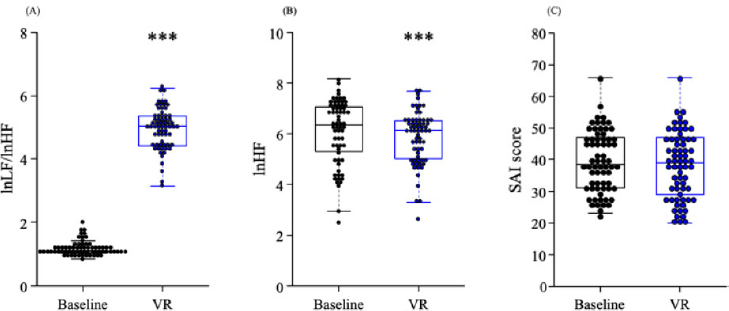
Changes in cardiac autonomic nervous system indices (A: lnLF/lnHF, and B: lnHF) and State Anxiety Inventory (SAI) scores (C) in response to the swimming VR exposure. Data are shown as beeswarm and boxplots, where the central horizontal line represents the median, the box indicates the Interquartile Range (IQR), and the whiskers extend to 1.5 times the IQR. ***; p < 0.001.
5. DISCUSSION
The present study was the first to demonstrate a method for measuring and real-time monitoring of the heart rates of 40 individuals during long-distance swimming.
We observed significant differences in heart rate during the long-distance swim between the groups indicates that there were differences in heart rate associated with swimming ability. Furthermore, there was a significant correlation between the average and maximum heart rates during the distance swim and the 400m breaststroke time, indicating that changes in heart rate are swim ability dependent. The relationship between swimming ability and oxygen demand in the pool has already been shown [18], and similar results were shown for long-distance swimming in the present study. On the other hand, our results showed no correlation between estimated maximal oxygen uptake and swimming ability. This indicates that swimming ability in the sea is not dependent upon maximum aerobic fitness capacity.
In study 1, significant differences were observed in heart rate changes during the long-distance swim between the groups (Fig. 2). Particularly noteworthy was the rapid increase in heart rate during the first 30 minutes of the swim for groups 4 and 5, who had lower swimming ability, when compared with groups 1, 2 and 3. In fact, the subject who dropped out showed a change that increased to 170 bpm in 10 minutes, swam at 170 bpm for an hour, and then showed a decrease to about 80 bpm in about 30 minutes. Furthermore, another subject quickly increased their heart rate from 130 bpm to 170 bpm, and then was given a rescue tube. It was reported that triathlon fatalities in the United States from 1985 to 2016 showed a cardiac arrest incidence rate of 1.74 per 100,000 [19]. Most of these incidents (66.7%) occurred during the swimming segment [19]. Among the victims who underwent autopsy, cardiovascular abnormalities were identified in 44% of cases [19]. The two subjects in this study had no cardiovascular abnormalities. At the least, it appeared that monitoring rapid heart rate increases during the early stages of swimming could serve as a preliminary indicator to assist in detecting physiological abnormalities, potentially contributing to safer long-distance swimming. The study used data from students taking a swimming training course as undergraduates, rather than an experiment that forced them to experience danger. The previous study needs to be examined in detail, but it is very difficult to obtain data on the accidents that occurred. Therefore, we think that the data obtained in the two cases this time are important. However, further studies are necessary to validate these exploratory findings, especially before considering applications for children.
Since it is extremely difficult and rare to collect near-miss data during long-distance swimming in the sea, this study explored the feasibility of using VR as a safe alternative method to simulate a stress environment. We first examined changes in autonomic nervous system activity from a simulated experience under VR exposure. Previous research has demonstrated that immersive VR scenarios can effectively induce and assess physiological regulation outcomes, including HRV, even within brief intervention windows [20]. It is known that LF/HF increases and HF decreases in response to acute stress [21]. We observed that the swimming VR exposure demonstrated the acute stress response. There was no difference in state anxiety scores obtained from the STAI before and after the swimming VR experience. This suggests that while the subjects may not have experienced conscious psychological anxiety, the observed changes in HRV likely reflect an unconscious, acute autonomic stress response to the simulated environment. It was reported that VR exposure for relaxation is associated with the decreasing LF/HF [22]. Accordingly, the study’s result of high sympathetic activity depends on the swimming VR exposure. In the future, the use of VR for various scenes will need to be considered as preliminary data to predict reactions during long-distance swimming.
6. LIMITATIONS
This study has several limitations. First, peak oxygen uptake (VO2 peak) was measured using a bicycle ergometer, which may not completely reflect actual swimming performance. Second, environmental factors in the sea (e.g., waves, water currents) were not strictly controlled. Third, there is a potential risk of artifacts or noise when using the wearable device in a water environment. Finally, the VR exposure involved only the immersion of the legs, which does not fully replicate the actual physical experience of swimming in the sea.
CONCLUSION
The real-time heart rate monitoring system used in this feasibility study was applicable under calm conditions, and the data obtained showed a relationship between swimming ability and heart rate. Furthermore, swimming VR demonstrated potential as an exploratory method to safely observe physiological responses in simulated environments. However, while these are promising exploratory tools, their clinical value and application for anomaly detection require further validation.
AUTHORS’ CONTRIBUTIONS
The authors confirm their contribution to the paper as follows: H.H.: Writing, original draft, project administration, methodology, investigation, funding acquisition, formal analysis, data curation and conceptualization; Y.N.: Editing, methodology, measurements, formal analysis and conceptualization; T.Ya.: Review, editing, methodology and measurements; T.T.: Review, editing, methodology, formal analysis and data curation; C.W., M.K.: Review, editing and measurements; E.O.: Review, editing and conceptualization; T.Yo., M.T., T.W.: Review & editing and methodology; M.J.K.: Writing, review and editing; H.M.: Writing, review, editing, methodology, formal analysis, data curation and conceptualization; H.Y.: Writing, review, editing, methodology and conceptualization. All authors reviewed the results and approved the final version of the manuscript.
LIST OF ABBREVIATIONS
| HF | = High Frequency |
| HR | = Heart Rate |
| LF | = Low Frequency |
| SAI | = State Anxiety Inventory |
| STAI | = State-Trait Anxiety Inventory |
| VO2 peak | = Peak oxygen uptake |
| VR | = Virtual Reality |
ETHICS APPROVAL AND CONSENT TO PARTICIPATE
The study protocols were approved by the Institutional Ethics Committee of Kawasaki University of Medical Welfare, Japan (Approval numbers: 23-046).
HUMAN AND ANIMAL RIGHTS
All procedures performed in studies involving human participants were in accordance with the ethical standards of institutional and/or research committees and with the 1975 Declaration of Helsinki, as revised in 2013.
CONSENT FOR PUBLICATION
Informed consent was obtained from all participants via an opt-out method, which was deemed appropriate because the data were collected as part of a regular university curriculum. Information regarding the study was publicly disclosed, and all participants were provided with the opportunity to decline the use of their data.
AVAILABILITY OF DATA AND MATERIALS
The data supporting the findings of this study are available from the corresponding author upon reasonable request.
FUNDING
This work was supported by the Japan Society for the Promotion of Science (JSPS) KAKENHI [grant number JP23K02379] (to H.H.) and the Sasakawa Scientific Research Grant from The Japan Science Society [grant number 2023-6025] (to H.H.).
ACKNOWLEDGEMENTS
The authors would like to thank the participants and the staff who assisted with the data collection and safety management during the long-distance swimming training and VR experiments.