All published articles of this journal are available on ScienceDirect.

Relationship between Bat Swing Speed and Rate of Force Development (RFD) in Bench Press among College Baseball Players
 iD
iD
Authors Info & Affiliations
Abstract
Introduction
A baseball bat swing is an explosive action completed within approximately 150–200 ms. Given this extremely short execution time, it is reasonable to assume that athletes with a higher Rate of Force Development (RFD) may be capable of producing faster swings. Despite this assumption, limited research has examined the relationship between bat swing speed and RFD, and few studies have specifically investigated how RFD measured during bench press movements relates to bat swing speed.
Methods
This study investigated the association between bat swing speed during tee batting and Maximum RFD obtained from bench press movements in 50 male collegiate baseball players (age: 20.1 ± 1.0 years; height: 173.2 ± 4.5 cm; body mass: 74.1 ± 7.4 kg).
Results
Bat swing speed showed significant positive correlations with Maximum RFD under absolute load conditions of 20, 30, and 50 kg. When estimated one-repetition maximum (1RM) was controlled for using partial correlation analysis, a significant relationship remained only at the 20 kg load. In addition, the strongest association with bat swing speed (r = 0.50) was identified at relative load levels corresponding to 20–29% of estimated 1RM. Players who recorded bat swing speeds of at least 100 km/h produced greater Maximum RFD values than their counterparts with slower swings, particularly under loads between 20 and 60 kg.
Discussion
Maximum RFD measured under relatively light loading conditions showed a close association with bat swing speed. Players with faster swings generally displayed a greater capacity for explosive force production, particularly within light to moderate load ranges.
Conclusion
Resistance training has traditionally focused on maximum strength (1RM). However, evaluating and improving Maximum RFD is equally important when developing training programs for sports that demand rapid and explosive actions.
1. INTRODUCTION
Baseball batting is an explosive movement performed within a very brief period. Bat swing speed is known to be a key factor influencing ball exit velocity [1]. When a pitch travels at approximately 40 m/s, the ball reaches the vicinity of home plate in about 425 ms after release. However, only part of this interval is actually available for executing the swing. Once the time required to recognize the pitch and anticipate its trajectory is accounted for, the effective duration for completing the swing is estimated at roughly 150–200 ms, based on findings from interceptive action studies [2].
Within such a narrow window, players must initiate force and complete the movement almost instantaneously. Performance therefore relies not only on the magnitude of force that can be generated but also on how quickly force can be produced, a quality generally referred to as the Rate of Force Development (RFD) [3].
Rate of Force Development (RFD) refers to the increase in force generated within a defined time period, typically within the first 0–200 ms following the onset of muscle contraction, and is widely used as an indicator of neuromuscular responsiveness [4]. The early phase of RFD is primarily influenced by neural factors and muscle fiber characteristics, whereas the later phase has been shown to depend more strongly on maximal muscle strength [5].
Among the values obtained during muscle contraction, the peak rate at which force is developed is described as Maximum RFD and is regarded as a highly sensitive measure of explosive force production capacity [4]. This parameter reflects the rapid recruitment of motor units and the capacity for high-frequency firing, making it particularly relevant for short-duration, high-intensity movements in sport settings [6]. RFD produced during voluntary maximal contractions is strongly influenced by how quickly and synchronously motor units are recruited by the central nervous system, together with their capacity for high-frequency firing [6]. Traditional measures of maximal strength, such as one-repetition maximum (1RM), primarily reflect the amount of force that can be generated when sufficient time is available. In many sport settings, however, performance depends more on how rapidly force can be produced. RFD therefore provides a useful index of rapid force-generation capability and allows assessment of the speed-dependent force production required for explosive movements.
The maximum force an athlete can generate is often limited by the time constraints associated with sport-specific actions. Previous studies have highlighted the importance of RFD in explosive activities such as vertical jumping, sprinting, and throwing [7, 8]. Based on these findings, athletes who exhibit greater RFD are also likely to achieve faster bat swing speeds.
Although RFD plays an important role in explosive movements, few studies have explored its relationship with bat swing speed in baseball. Evidence specifically examining how RFD measured during bench press movements relates to swing speed remains limited.
Previous studies examining the relationship between maximal strength and bat swing speed have reported inconsistent findings. Some investigations have identified a significant positive association between bench press 1RM and swing speed [9], whereas others have not observed such a relationship [10]. These mixed results suggest that 1RM alone may not fully represent the capacity for explosive force production.
During actions such as batting, where force must be produced within an extremely short time, the ability to generate force rapidly, namely RFD, may be more closely linked to performance. RFD characteristics also vary depending on the magnitude of the applied load. Under lighter loads, neural responsiveness appears to play a greater role, whereas under heavier loads the influence of maximal muscle strength becomes more pronounced [5].
On the other hand, in complex whole-body movements such as the bat swing, it is difficult to directly assess RFD, and no method has been fully established for quantifying muscle force output during such movements with high accuracy and reproducibility [3]. The bench press is a representative exercise that allows upper-body force production to be assessed under controlled conditions, with the advantages of relatively easy manipulation and measurement of load and movement velocity. Therefore, although the measurement of RFD during the bench press does not directly replicate the bat swing, it may serve as a useful indicator for evaluating one aspect of the neuromuscular explosive capacity that contributes to swing speed.
In light of these considerations, this study measured Maximum RFD during bench press exercises performed under several load conditions in collegiate baseball players and examined how Maximum RFD at each load relates to bat swing speed. Furthermore, it was hypothesized that RFD during the bench press would be positively associated with bat swing speed, and that this relationship would vary depending on the loading conditions.
2. MATERIALS AND METHODS
2.1. Participants
The participants were 50 Japanese male collegiate baseball players (age 20.1 ± 1.0 years, height 173.2 ± 4.5 cm, weight 74.1 ± 7.4 kg). All participants were position players, including 8 catchers, 24 infielders, and 18 outfielders. The participants were members of a collegiate baseball team that advanced to the top eight in a national tournament and were therefore considered to be of a relatively high competitive level. However, detailed information regarding individual training histories was not available.
All participants were fully informed about the purpose of the study, measurement procedures, and any potential risks before participation. Written informed consent was obtained from each participant, and they were informed of their right to withdraw from the study at any time. Eligibility for participation required voluntary written informed consent and approval from each participant's baseball team coach. Participants were excluded if they had severe or progressive medical conditions, orthopedic disorders affecting daily activities or baseball perfor-mance, or if they were deemed unsuitable for participation by the principal investigator.
The study protocol was approved by the Fukuoka University Research Ethics Review Committee (Approval No. 25-01-04) and conducted in accordance with the principles of the Declaration of Helsinki.
2.2. Measurement Items and Methods
2.2.1. Bench Press Measurement
All participants were familiar with bench press training and completed a light-load warm-up prior to testing. Measurements were conducted before regular practice sessions to minimize the influence of fatigue. This study was conducted in February 2025.
Bench press testing was performed in the supine position while maintaining five points of contact: the head, upper back, buttocks, and both feet. Grip width was individually selected and kept constant across all trials. Each participant began with the elbows fully extended, lowered the bar under control, and briefly paused when the bar reached the nipple line over the upper pectoral region. They were told to lift the barbell at the maximum possible speed without using momentum and without lifting their body off the bench. The load was increased in 10kg increments starting from 20kg, continuing until the participant could no longer perform the lift, with the maximum load set at 80kg. The number of lifts attempted at each load was limited to a maximum of three trials. A rest period of at least three minutes was observed between load changes.
To calculate the estimated 1RM, the barbell lifting speed was measured. Measurements were conducted using an inertial measurement unit (Enode; BM Sports Technology GmbH, Germany), as it enables practical and highly reproducible assessments in field settings. The reliability of the Enode device has been previously established [11]. Barbell velocity was assessed using mean concentric velocity, given the high linearity of the load–velocity relationship and its strong predictive accuracy [12]. The estimated one-repetition maximum (1RM) was determined based on the load corresponding to a velocity of 0.17 m/s. To calculate the estimated 1RM, a regression equation based on the load-velocity relationship was used. Substituting the velocity of 0.17 m/s into this regression equation estimated the load equivalent to 1RM. This velocity value has been shown in previous studies as the average concentric velocity during 1RM bench presses [13]. Maximum RFD was obtained from the values automatically calculated by the Enode device. The Enode measures barbell acceleration using an embedded accelerometer and its proprietary algorithm, and estimates force based on the barbell mass and acceleration according to the equation F = m × (a + g), thereby generating a force–time curve. From this force–time curve, RFD was calculated as the rate of change in force over time (Δforce/Δtime).
To determine RFD, a 40-ms moving window was applied across the entire concentric phase. The highest rate of force development observed within these intervals was identified as the Maximum RFD, and the greatest value obtained across all trials was used for subsequent analysis. Due to the specifications of the Enode device, RFD could only be calculated using this 40-ms moving window.
The inertial sensor was attached near the center of the barbell, and all data were displayed in real time on a tablet device via a dedicated application.
2.2.2. Bat Swing Speed Measurement
Participants performed tee batting toward a net positioned in front of the batter, striking the ball placed on the tee with maximal effort. Tee height was adjusted to the waist level of each participant, and the target area was aligned with home plate. Each participant completed three tee batting trials, and the trial producing the highest bat swing speed was used for analysis.
All swings were performed using standardized hardwood bats manufactured by Mizuno (length: 84 cm; mass: 890 g). Bat swing speed was measured with the BLAST BASEBALL system (inertial measurement unit; Blast Motion). A sensor attached to the bat grip transmitted swing data to a dedicated tablet-based application for display and analysis. BLAST BASEBALL has demonstrated reliability in measuring bat swing speed and measures the swing speed at the sweet spot of the bat, rather than the head speed commonly used in baseball research [14].
2.3. Statistical Analysis
An a priori sample size calculation was performed. Based on a two-tailed test, an assumed effect size (correlation coefficient, ρ) of 0.5, an alpha level of 0.05, and a statistical power of 0.95, the required sample size was estimated to be 42. Therefore, a total of 50 participants were included in this study, exceeding the minimum required sample size. Values for each measure-ment item are presented as mean ± standard deviation. Pearson's correlation coefficient was used to examine the relationship between bat swing speed and Maximum RFD. Furthermore, partial correlation coefficients were calculated for the relationship between bat swing speed and Maximum RFD, controlling for estimated 1RM as a covariate. An independent two-sample t-test was per-formed to compare the difference in Maximum RFD between the group with bat swing speed exceeding 100 km/h and the group below this threshold. The significance level in this study was set at <5% for statistical significance. Statistical analysis was performed using IBM SPSS Statistics 26 (IBM).
3. RESULTS
3.1. Measurement Values
For the bench press measurement, all 50 participants were able to perform the test at 20–40 kg. At 50 kg, 48 participants were able to perform the test; at 60 kg, 43 participants; at 70 kg, 35 participants; and at 80 kg, 15 participants. The results of the measurements are shown in Table 1.
| Measure | Mean±SD |
|---|---|
| Number of Participants | 50 |
| Age (years) | 20.1±1.0 |
| Height (cm) | 173.2 ±4.5 |
| Body Weight (kg) | 74.1±7.4 |
| Bat Swing Speed (km/h) | 101.2±5.9 |
| Estimated 1RM (kg) | 75.5±11.2 |
3.2. Relationship between Maximum RFD and Estimated 1RM at each Load Condition and Bat Swing Speed
Figure 1 shows the correlation coefficients between Maximum RFD and estimated 1RM versus bat swing speed under each load condition. A significant positive correlation was observed between bat swing speed and Maximum RFD under the 20, 30, and 50 kg load conditions (p < 0.01). A significant positive correlation was observed between bat swing speed and estimated 1RM (p < 0.01) (Table 2). Based on these results, partial correlation coefficients were calculated with estimated 1RM as the control variable to examine the independent effect of Maximum RFD on bat swing speed (Table 3). The results showed a significant positive correlation between Maximum RFD and bat swing speed under the 20 kg load condition (p < 0.05). Furthermore, relative values (%1RM) for each load weight were calculated based on estimated 1RM, load categories were established in 10% increments, and correlation coefficients between Maximum RFD and bat swing speed were calculated for each relative load band (Table 4). The results showed that only in the 20–29% 1RM relative load condition was the highest (r = 0.50) significant positive correlation between Maximum RFD and bat swing speed observed (p < 0.01).
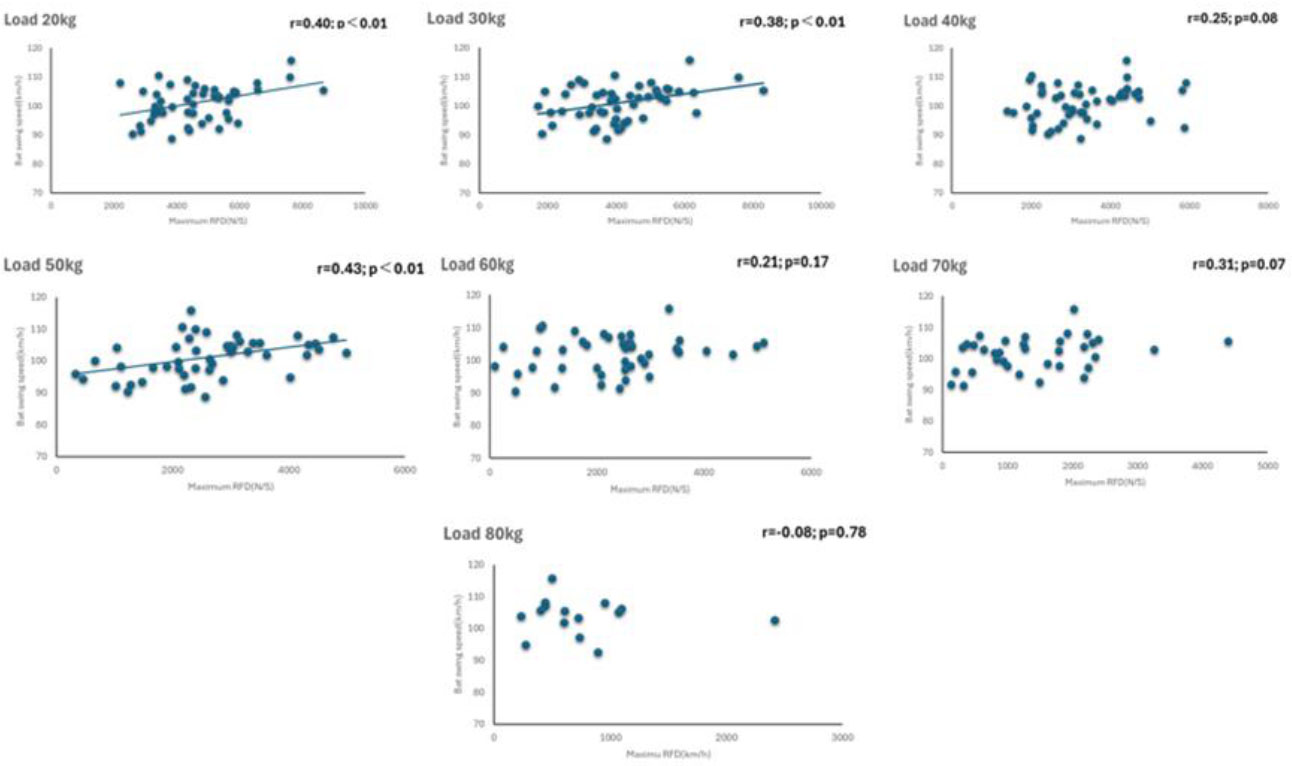
Relationship between bat swing speed and maximum RFD at each bench press load condition.
Note: Max RFD = Maximum Rate of Force Development.
| Variable | Correlation Coefficient (r) | p-value |
|---|---|---|
| Estimated 1RM (kg) | 0.36 | 0.009** |
Note: ** p < 0.01.
| Variable | Partial Correlation (r) | p-value |
|---|---|---|
| Max RFD (20 kg) | 0.304 | 0.037* |
| Max RFD (30 kg) | 0.236 | 0.110 |
| Max RFD (50 kg) | 0.236 | 0.110 |
Note: * p < 0.05.
| Relative Load (%) | Max RFD (N/s) Mean ± SD | Correlation Coefficient (r) | p-value |
|---|---|---|---|
| 20–29 | 4660.5 ± 1350.6 | 0.50 | 0.002** |
| 30–39 | 4367.0 ± 1241.0 | 0.11 | 0.114 |
| 40–49 | 3987.5 ± 1242.9 | 0.29 | 0.101 |
| 50–59 | 3242.0 ± 896.3 | 0.07 | 0.661 |
| 60–69 | 2840.1 ± 903.1 | 0.28 | 0.063 |
| 70–79 | 2325.0 ± 836.6 | 0.09 | 0.630 |
| 80–89 | 1650.8 ± 953.2 | 0.05 | 0.756 |
| 90–100 | 675.8 ± 463.5 | 0.24 | 0.205 |
Note: Max RFD = Maximum rate of force development; ** p < 0.01.
3.3. Comparison between Groups with Bat Swing Speeds Exceeding 100 km/h and those below 100 km/h
As an additional analysis, participants were divided into two groups based on a bat swing speed threshold of 100 km/h, and differences in Maximum RFD between the groups were examined. Table 5 shows the results comparing Maximum RFD between the group with bat swing speeds exceeding 100 km/h (n=29) and the group below 100 km/h (n=21). Since the mean bat swing speed in this study was 101.2 km/h, a practical threshold of 100 km/h was used to separate the groups. Results from an independent two-sample t-test showed that under load conditions of 20–60 kg, the Maximum RFD in the group exceeding 100 km/h was significantly higher than that in the group below 100 km/h.
| Load | Group ≥100 km/h (N/s) | Group <100 km/h (N/s) | p-value |
|---|---|---|---|
| 20 kg | 5057.9 ± 1511.7 | 4098.1 ± 1287.1 | 0.009** |
| 30 kg | 4547.1 ± 1511.7 | 3588.9 ± 991.4 | 0.011* |
| 40 kg | 3625.9 ± 1120.6 | 2915.6 ± 882.2 | 0.026* |
| 50 kg | 3108.6 ± 1031.9 | 1924.3 ± 858.9 | 0.000** |
| 60 kg | 2601.3 ± 979.8 | 1818.4 ± 732.6 | 0.024* |
| 70 kg | 1611.3 ± 991.6 | 1106.5 ± 692.9 | 0.096 |
| 80 kg | 790.0 ± 558.2 | 634.7 ± 407.8 | 0.559 |
Note: Max RFD = Maximum Rate of Force Development; Group ≥100 km/h = participants with bat swing speed ≥100 km/h; Group <100 km/h = participants with bat swing speed <100 km/h; * p < 0.05; ** p < 0.01.
4. DISCUSSION
This study examined Maximum RFD during bench press movements across multiple load conditions in collegiate baseball players and explored its relationship with bat swing speed. Significant positive correlations between bat swing speed and Maximum RFD at loads of 20, 30, and 50 kg suggest that rapid force production contributes substantially to batting performance, particularly in actions that must be completed within a very short time.
A baseball swing is an explosive movement typically completed within approximately 150–200 ms [2], and this narrow time window has a strong influence on both swing speed and ball exit velocity. Under such constraints, performance is determined not only by maximal muscle strength but also by how quickly force can be generated, a capability commonly described as the Rate of Force Development (RFD). Maximum RFD generally occurs within the first 100 ms and is thought to reflect neural mechanisms such as rapid motor unit recruitment, synchronized activation, and high-frequency firing within the central nervous system [15]. The results of this study are consistent with these reports, demonstrating that the relationship between bat swing speed and Maximum RFD emerges under relatively light-to-moderate load conditions. At lighter to moderate loads (20, 30, and 50 kg), where a significant positive correlation was observed, the ability to perform explosive contractions at higher movement velocities may indicate that RFD influenced by neural factors plays a meaningful role. In contrast, no significant correlation was observed between Maximum RFD and bat swing speed at load conditions of 60 kg or higher. As external load increases, lifting velocity decreases and movement duration becomes longer, which may attenuate neural contributions to RFD while increasing reliance on muscular strength-related factors associated with late-phase RFD [5]. Consequently, high-load force production capacity may be less directly involved in short-duration, high-speed actions such as the batting swing. However, since the present study did not directly assess these neural factors, caution is warranted when interpreting the findings in relation to underlying neurophysiological mechanisms. Therefore, although the observed relationships may suggest an association with neural factors, they do not provide direct evidence of a causal link. In this study, a significant positive correlation was found between estimated 1RM and bat swing speed. When estimated 1RM was controlled as a variable in partial correlation analysis, a significant positive correlation was observed only under the 20 kg load condition. This result suggests that even among light loads, the maximum RFD at 20 kg specifically contributes to bat swing speed independently of maximum strength.
On the other hand, for weights exceeding 30 kg, it was suggested that not only Maximum RFD but also maximum strength is involved. Given several issues noted with estimating 1RM [16], the Maximum RFD at the 20kg condition may be useful as an evaluation metric for bat swing speed from a different perspective than maximum strength. Furthermore, the strongest significant positive correlation (r = 0.50) was identified between Maximum RFD and bat swing speed at a relative load of 20–29% of estimated 1RM. These results extend the findings obtained under the absolute 20 kg condition and indicate that generating RFD within a particular relative load range is closely linked to batting speed performance, rather than being determined solely by maximal strength or absolute RFD magnitude.
In strength training research, relative loads below 30% of 1RM have commonly been described as the “speed zone,” a range considered effective for developing explosive strength [17]. The influence of this load range on RFD supports the present observations.
Significant differences in Maximum RFD across load conditions (20–60 kg) were observed between players with bat swing speeds above 100 km/h and those with slower swings. These findings indicate that athletes capable of faster swings tend to exhibit greater overall explosive force production capacity, supporting the usefulness of Maximum RFD as a potential indicator of bat swing performance. Kinematic analyses from previous studies have shown that the peak angular velocity of the elbow joint of the bottom hand was 35.9% higher in highly skilled players than in lower-skill players [18]. A clear link between these kinematic findings and the RFD measure-ments obtained in this study cannot be established. Nevertheless, the difference may be associated with rapid arm extension during the swing motion. This variation appears to reflect differences in explosive performance during the rotational and acceleration phases of the upper-limb movement, where Maximum RFD may contribute. On the other hand, in the present study, bat swing speed was dichotomized into two groups using a threshold of 100 km/h. However, dichotomizing a continuous variable in this manner may lead to a loss of information and reduced statistical power. Therefore, these analyses should be interpreted as exploratory or supplementary in nature.
Among collegiate baseball players, Maximum RFD measured under light-load conditions corresponding to approximately 20–30% of the estimated 1RM, particularly at an absolute load of 20 kg, showed a strong association with bat swing speed. Players who achieved faster swings also produced greater Maximum RFD under light to moderate loading conditions. These findings suggest that the ability to produce force rapidly under neural control may be associated with batting performance.
The findings of this study suggest the importance of evaluating explosive force production in addition to maximal strength, and may provide useful insights for reconsidering strength assessment in baseball players. Traditionally, maximal strength (1RM) has been emphasized as a key training indicator; however, in sports that require explosive movements, incorporating the assessment of Maximum RFD may lead to a more practical understanding of performance-related strength. Future research should further explore frameworks for strength evaluation that take into account both maximal strength and Maximum RFD.
This study has several limitations. The collegiate baseball players included in the analysis represented a specific competitive level, and comparisons with athletes from other levels were not performed. In addition, only Maximum RFD was examined. RFD can be divided into an early phase occurring within the first 100 ms and a later phase thereafter, each reflecting different physiological mechanisms. In the present study, neural activity was not assessed using Electromyography (EMG); therefore, the involvement of neural factors could not be directly examined. Future work should analyze early and late RFD separately and incorporate electromyographic evaluation of neural activity to further clarify their relationship with bat swing speed.
In the present study, RFD was assessed using the bench press, a linear and bilateral movement; however, the bat swing is a multi-joint action involving rotational components and represents a complex movement based on the kinetic chain. Therefore, the sport-specific validity of the RFD measures obtained in this study may be limited.
In addition, a barbell velocity of 0.17 m/s was used as the reference for estimating 1RM; however, this velocity may not necessarily reflect a true maximal effort for all participants. Differences in individual load–velocity profiles may have introduced some degree of error in the estimated values.
CONCLUSION
The present study examined the relationship between bat swing speed and Maximum RFD during the bench press in collegiate baseball players. The results suggest that Maximum RFD under lighter load conditions may be associated with bat swing speed. These findings indicate that assessing explosive force production may provide useful insights into performance, highlighting the importance of considering temporal characteristics of force development in addition to traditional measures of maximal strength.
Furthermore, the framework used in this study to evaluate RFD across multiple loading conditions may have broader applicability beyond baseball, potentially serving as a useful approach for assessing explosive muscle performance in sports that require rapid force production.
However, as this was a cross-sectional study, the observed relationships should not be interpreted as causal. Future research using training interventions or longitudinal designs is needed to further clarify the relationship between Maximum RFD and performance.
AUTHORS’ CONTRIBUTIONS
The authors confirm their contributions to this work as follows: K.I., R.M., and M.T.: Contributed to the conceptualization and study design; K.I. and M.W.: were responsible for data collection and investigation; K.I. and M.T.: Performed the data analysis and interpretation; K.I.: Drafted the manuscript; K.I., R.M., M.W., and M.T.: Reviewed and approved the final version of the manuscript.
LIST OF ABBREVIATIONS
| RFD | = Rate of Force Development |
| 1RM | = One-Repetition Maximum |
ETHICS APPROVAL AND CONSENT TO PARTICIPATE
Ethical approval was obtained from the Fukuoka University Research Ethics Review Committee, Japan (Approval No. 25-01-04).
HUMAN AND ANIMAL RIGHTS
All human research procedures followed were in accordance with the ethical standards of the committee responsible for human experimentation (institutional and national), and with the Helsinki Declaration of 1975, as revised in 2013.
AVAILABILITY OF DATA AND MATERIALS
The data supporting the findings of this study are available from the corresponding author [M.T.] upon reasonable request.
ACKNOWLEDGEMENTS
Declared none.