All published articles of this journal are available on ScienceDirect.

Proprioceptive Neuromuscular Facilitation for Athletic Performance and Rehabilitation: A Narrative Review

Abstract
Introduction
Proprioceptive neuromuscular facilitation (PNF) is increasingly applied beyond rehabilitation to athletic performance training, yet direct evidence in athletes is limited and scattered across clinical and non-athlete literature.
Methods
In this narrative review, literature published mainly between 2015 and 2025 was identified by a single author through non-systematic, iterative searches of PubMed, Semantic Scholar, and Google Scholar and by reference-list checking, without fixed search strings or formal screening. Sources were classified as direct PNF evidence in athletes or physically active individuals, direct PNF evidence in clinical populations, or indirect evidence from the broader neuromuscular training, motor learning, and rehabilitation literature.
Results
Fourteen PNF-specific sources were identified, including three primary studies in athletes. Direct evidence was most consistent for range of motion. Findings for strength, power, and agility were mixed: in athletes, PNF was not superior to other stretching methods, and one systematic review reported acute performance decrements after PNF stretching. Clinical studies (e.g., stroke, low back pain) reported improvements in pain, balance, and gait, but these cannot be generalized to athletes. No PNF study measured injury incidence, return-to-sport outcomes, or markers of neuroplasticity.
Discussion
PNF may be viewed as a component of broader neuromuscular training rather than solely as a stretching technique. Its links to injury-related factors, motor learning, and neuroplasticity are potential mechanisms inferred from indirect evidence rather than established outcomes.
Conclusion
Direct evidence for PNF is currently most consistent for range of motion; effects on performance are mixed, and effects on injury risk and neuroplasticity in athletes remain hypothetical. Randomized trials using standardized PNF protocols in clearly defined populations of athletes are needed.
1. INTRODUCTION
Training aimed at enhancing athletic performance and preventing injuries focuses on boosting competitive performance, reducing injury risk, and facilitating a safe return to sport. Traditionally, rehabilitation and conditioning approaches emphasized strengthening specific muscles and improving flexibility. However, the perspective has recently shifted toward prioritizing integrated neuromuscular control and functional movement patterns, which better reflect the demands of dynamic sports environments [1, 2]. This shift mirrors a broader conceptual change in the understanding of motor skills: they are now viewed not merely as the product of individual muscle output but as the result of coordinated interactions among neuromuscular and sensorimotor systems [1, 3].
Proprioceptive Neuromuscular Facilitation (PNF) is a therapeutic approach that utilizes specific movement patterns, resistance, and sensory input to facilitate neuromuscular activation and coordination [4]. Rather than viewing PNF merely as a stretching technique, it is best understood as a framework for neuromuscular facilitation that integrates sensory input and motor output through resistance, manual contact, and facilitated movement patterns. Although originally developed for neurological rehabilitation, PNF is associated with improvements in range of motion (ROM) and has been shown to reduce pain and disability in certain clinical populations [5, 6]; however, direct evidence regarding the specific effects of PNF on muscle strength in athletes remains limited (see Section 3.2). The application of PNF is increasingly extending into athletic performance enhancement and injury-risk management-areas where movement quality, timing, and coordination are critical determinants of performance. It has been suggested that incorporating PNF into functional training may enhance movement efficiency and contribute to performance-related outcomes. However, as detailed in this review, much of this evidence is indirect, often derived from broader literature on stretching or neuromuscular training rather than from clinical trials specifically targeting PNF [7, 8]. Consequently, the sport-specific role of PNF-particularly its impact on optimizing athletic performance and influencing injury-related factors-has not yet been fully elucidated. Meanwhile, advancements in research on motor learning and neuroplasticity have transformed approaches to rehabilitation and performance training. Key principles such as repetition, task specificity, and variability are widely recognized as essential for long-term skill acquisition and neural adaptation [9-11]. PNF aligns conceptually with these principles by emphasizing active participation, sensory input, and task-oriented facilitation, thereby suggesting a potential role that extends beyond traditional clinical applications. However, whether PNF itself induces neuroplastic adaptations has not been directly verified; this review examines that possibility as a hypothesis (Section 3.5) [12, 13].
Research on general resistance training and sensorimotor integration identifies neuromuscular control and proprioception as critical factors for movement quality and reducing injury risk, particularly in high-intensity sports settings [14, 15]. While the specific contribution of PNF to these mechanisms has not yet been directly proven, this review critically examines the topic (Section 3.3). Modern sports rehabilitation has evolved toward a more comprehensive perspective, acknowledging that psychological, social, and environmental factors-alongside physical capabilities-influence athletic performance. This aligns with the biopsychosocial rehabilitation model, which emphasizes integrating physical and non-physical elements to optimize functional outcomes [16]. From this broader perspective, PNF may support a comprehensive approach by addressing physical limitations and potentially encouraging active engagement in movement, although these psychological effects have not been tested directly. This is particularly significant in “return-to-sport” decision-making, where physical readiness alone may not fully reflect an athlete's capacity for safe and effective performance [17]. Despite this conceptual potential, current literature on PNF remains fragmented and lacks conceptual integration regarding sport-specific applications. Specifically, while PNF research has primarily focused on clinical patients or non-athlete populations, broader studies on sports injuries and performance-such as those addressing return-to-sport following anterior cruciate ligament (ACL) reconstruction or neuromuscular training for female athletes-have largely developed independently of PNF research [18-20]. While concepts related to motor learning and neurorehabilitation have been extensively studied in other fields, an integrated conceptual framework that clearly links these principles to PNF in sports contexts has not been clearly established. Given this gap, a more integrated conceptual synthesis is required. Accordingly, this review examines whether PNF can be productively redefined not merely as a therapeutic technique, but as a component of an integrated neuromuscular training approach aimed at enhancing athletic performance and addressing injury-related factors. In doing so, a clear distinction is made between direct evidence regarding PNF and broader, inferential evidence concerning its implications for injury-related factors, neuroplasticity, and athletic performance. Evidence obtained in clinical populations (e.g., stroke, low back pain) is presented separately from evidence obtained in athletes or physically active individuals and is used only to inform potential mechanisms.
2. MATERIALS AND METHODS
2.1. Literature Search
This study was conducted as a narrative review examining the potential role of PNF in terms of athletic performance training, injury prevention, and neuroplasticity. Literature searches were iteratively conducted in PubMed, Semantic Scholar, and Google Scholar using combinations of keywords related to PNF, sports rehabilitation, motor control, athletic performance, and neuromuscular training, and supplemented by a manual review of reference lists from relevant studies. The search process was exploratory and iterative rather than restricted to a single predefined search string or a specific timeframe; consequently, papers providing foundational or mechanistic context-such as early descriptions of PNF techniques or motor learning theories-were included in the analysis even if they fell outside the review's primary timeframe of interest. Literature selection and synthesis were carried out by a single author. Relevance was judged informally on reading titles, abstracts, and full texts; search strings, search dates, and the numbers of records retrieved or screened were not recorded, so no study-selection flow diagram or record counts are reported. No predefined eligibility criteria were applied during searching. During revision, however, every cited source was re-checked and retained only if it (a) was a peer-reviewed article or an established textbook, (b) was available in full text in English, and (c) either evaluated a PNF intervention in any population or addressed neuromuscular control, motor learning, neuromuscular training, or return to sport in a way directly relevant to interpreting PNF. Sources failing these criteria (e.g., unpublished or unverifiable material and citations not supporting the associated claim) were removed. These criteria were therefore applied post hoc and do not constitute a reproducible selection protocol. As this study followed a narrative review format rather than a systematic review, formal procedures such as fixed search strings, predefined search periods, independent screening by two researchers, and PRISMA-style flow diagrams were not applied. These methodological choices and the associated implications for reproducibility are acknowledged as limitations of this review (Section 4.6).
2.2. Narrative Synthesis Approach
The selected literature was reviewed and interpreted descriptively, with a focus on neuromuscular activation, sensorimotor integration, motor learning, injury prevention, rehabilitation, and return-to-sport applications. Both sports-related and selected clinical studies were considered if they contributed to an understanding of the neurophysiological and functional mechanisms underlying PNF. A quantitative synthesis was not performed due to heterogeneity in study designs, participant characteristics, intervention methods, and outcome measures. Instead, the findings were interpreted descriptively to provide an integrated, conceptual perspective on the role of PNF in athletic performance training and injury-related factors. Priority was given to peer-reviewed studies-including experimental research, systematic reviews, and clinically significant studies-addressing neuromuscular control, movement quality, rehabilitation, and sports performance.
2.3. Evidence Classification
To distinguish PNF-specific evidence from the broader literature, each cited source was assigned to one of three categories. (1) Direct PNF evidence in athletes or physically active individuals: primary studies or evidence syntheses in which PNF was the intervention of interest and participants were athletes or healthy, physically active adults (Table 1, sections A and B). (2) Direct PNF evidence in clinical populations: studies in which PNF was the intervention of interest in patients (e.g., stroke, chronic low back pain, knee or ankle disorders) (Table 1, section C). These studies were used only to inform potential mechanisms and are not interpreted as evidence of effects in athletes. (3) Indirect evidence: literature on neuromuscular, resistance, and balance training, motor learning, neurorehabilitation, and return to sport that did not evaluate PNF (Table 2). Throughout the Results and Discussion, statements based on categories 2 or 3 are presented as potential mechanisms or hypotheses rather than as established effects of PNF, and Fig. (1) uses distinct visual codes for direct and conceptual evidence.
| Ref. | Study Design / Population | PNF Intervention (vs. Comparator) | Outcomes Measured | Duration | Key Finding/limitation |
|---|---|---|---|---|---|
| A. Athletes (direct PNF evidence; n = 3) | |||||
| [21] | RCT; Athlete (youth basketball) | PNF vs. passive stretching | Speed, agility, explosive power | Acute | Within-group agility gain only (p=.05); no between-group difference; passive stretching showed greater power gains. |
| [22] | RCT; Athlete (collegiate badminton) | PNF vs. dynamic stretching | Flexibility, agility, balance | Not specified | No significant difference vs. dynamic stretching; no non-stretching control group. |
| [24] | Experimental; Athlete (team sports players) | 8-week PNF stretching | Hamstring strength, neuromuscular activity | 8 weeks | Increased hamstring strength and neuromuscular activity after 8 weeks in team-sport athletes (no non-PNF comparator group). |
| B. Healthy or physically active non-athletes (direct PNF evidence; n = 4) | |||||
| [25] | Experimental (elastography); Healthy/general adults | Acute PNF stretching | Rectus femoris stiffness | Acute | No significant change in stiffness after acute PNF stretching. |
| [26] | Meta-analysis (partial); Mixed | Stretch-induced force deficit (incl. PNF) | Force/strength deficit | Acute | No PNF-specific protective effect identified; PNF is a subset within a broader meta-analysis. |
| [23] | Systematic review (incl. PNF); General active adults | Acute stretching incl. PNF | Performance, ROM, injury incidence | Acute | PNF associated with ~-4.4% acute performance decrease. |
| [38] | Experimental; Healthy, n=18 | Single-session PNF ± post-activation | Plantar flexor muscle function | Single session | PNF alone significantly decreased MVIC peak torque (-4%, p=.01) despite a comparable increase in ROM (+4%); no significant change in muscle stiffness for the PNF-only condition; very small sample. |
| C. Clinical populations (direct PNF evidence; mechanistic context only, not generalizable to athletes; n = 7) | |||||
| [5] | Systematic review/meta-analysis; Clinical (chronic low back pain) | PNF training | Pain, disability | Not specified | Reduced pain/disability; clinical, non-athletic population. |
| [31] | Systematic review/meta-analysis; Clinical (chronic stroke) | PNF-based physical therapy | Balance, gait | Not specified | Improved balance/gait; neurological population. |
| [39] | RCT; Clinical (chronic low back pain) | PNF vs. Pilates | Pain/function | Not specified | Comparable/favorable outcomes vs. Pilates; clinical, comparator-specific. |
| [40] | Systematic review/meta-analysis; Clinical (knee injury patients) | PNF therapy | Functional recovery | Not specified | Improved functional recovery; clinical injury population; published 2026 (outside the review's primary 2015-2025 window; retained for topical relevance). |
| [41] | RCT; Clinical (older adults) | PNF technique | Posture, balance, gait | Not specified | Improved posture/balance/gait; older clinical population. |
| [42] | Systematic review/meta-analysis; Clinical (chronic ankle instability) | PNF | Balance/functional outcomes | Not specified | Improved ankle-instability outcomes; clinical population. |
| [43] | Study; Clinical (knee osteoarthritis, 40-70y) | PNF | Balance, gait | Not specified | Improved balance/gait; older clinical population. |
| Domain | PNF-related Mechanism (Evidence type) | Supporting Evidence | Functional Outcomes | Clinical Implications |
|---|---|---|---|---|
| Flexibility and ROM | Increased stretch tolerance and neuromuscular facilitation associated with PNF stretching techniques [Direct (most consistent domain)] | Hindle et al. [4]; Reiner et al. [38] | Increased ROM; effect on subsequent performance is mixed, not uniformly neutral (see Section 3.2) | Can be incorporated into warm-up/mobility work, with awareness of possible acute performance trade-offs |
| Neuromuscular activation | Proposed enhancement of motor-unit recruitment and intermuscular coordination via resistance, manual contact, and task-specific facilitation [Indirect / hypothesized] | Hindle et al. [4] (mechanistic review); Reiner et al. [38] (n=18, single session) | Not empirically confirmed at group level for coordination/force transmission broadly | Plausible mechanism; not directly demonstrated |
| Sensorimotor integration | Enhanced proprioceptive input and interaction between feedback and feedforward control processes [Indirect/mechanistic] | Proske and Gandevia [3] (general physiology); Hindle et al. [4] | Hypothesized improvements in balance, postural control, and movement accuracy | Plausible but untested in PNF-specific trials |
| Injury-related risk factors | Improvements in neuromuscular control, coordination, and movement quality associated with training interventions generally [Indirect / extrapolated (no PNF trial measured injury incidence)] | Sugimoto et al. [20]; Gokeler et al. [30] (neither is a PNF study) | Reduced injury risk factors (e.g., asymmetry, poor neuromuscular control) - from broader NMT literature, not PNF trials | Consistent with injury-risk-reduction principles based on broader neuromuscular training, not direct PNF-specific evidence |
| Motor learning and adaptation | Repetition, task specificity, and variability aligned with established motor learning principles [Indirect/theoretical alignment] | Schmidt et al. [13]; Maier et al. [35] (neither is a PNF study); Hindle et al. [4] | Hypothesized improvements in movement adaptability, coordination, and motor performance | Theoretical extension of motor-learning theory to PNF; not demonstrated |
| Return-to-sport transition | Integration of neuromuscular control with task-specific and sport-related movement demands [Indirect / no direct PNF evidence] | Ardern et al. [34]; Buckthorpe [33]; Gokeler et al. [30] (none are PNF studies) | Hypothesized readiness, confidence, and functional performance gains in dynamic contexts | Conceptually consistent with structured return-to-sport frameworks; not evidenced by PNF trials |
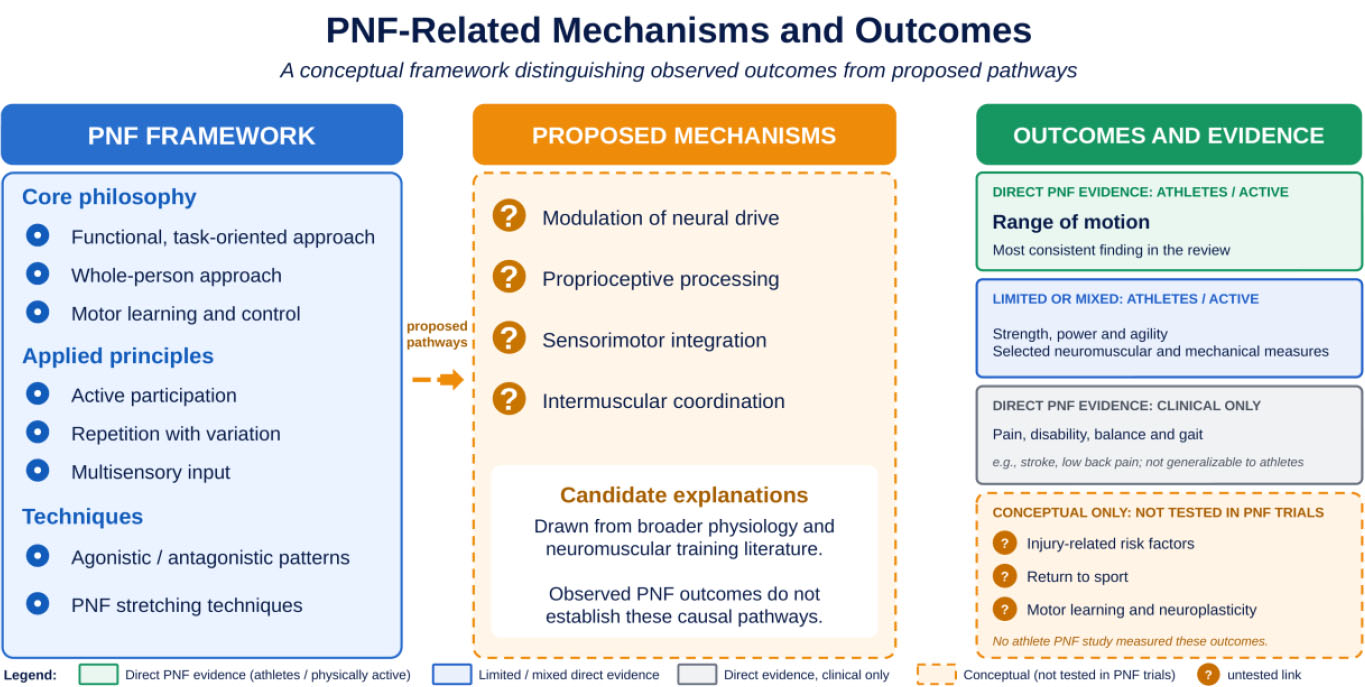
Conceptual framework linking proprioceptive neuromuscular facilitation (PNF) to athletic performance, injury-related factors, and neuroplasticity. Solid borders indicate outcomes with direct PNF evidence, separated into athletes/physically active individuals and clinical populations; dashed borders, dashed arrows, and question marks indicate potential mechanisms and applications extrapolated from the broader neuromuscular training and neurorehabilitation literature that have not been demonstrated in PNF trials.
3. RESULTS
3.1. Characteristics of the PNF-specific Literature
Because no formal screening protocol was used, the numbers of records identified, screened, or excluded were not recorded, and no study-selection flow diagram is presented. The 14 PNF-specific sources summarized in Table 1 are all of the cited sources in which PNF was the intervention of interest (categories 1 and 2, Section 2.3). They comprise three primary studies in athletes, four studies or evidence syntheses in healthy or physically active non-athletes, and seven studies or evidence syntheses in clinical populations. All other cited sources provide indirect, mechanistic, or contextual evidence (category 3; Table 2).
Across the identified PNF-related literature, PNF interventions were administered using various techniques-such as contract-relax, hold-relax, and rhythmic stabilization-and were utilized either as standalone stretching interventions or within the broader context of neuromuscular or functional training. Reported outcome measures included ROM, muscle strength, balance, agility, and movement efficiency; however, no data regarding direct injury incidence rates were identified in the reviewed PNF literature. The body of evidence varied in terms of study design (e.g., randomized controlled trials, single-session experimental studies, systematic reviews/ meta-analyses) and target populations. While the majority of PNF-related studies focused on clinical populations (e.g., individuals with chronic low back pain, stroke, knee osteoarthritis, or ankle instability) or healthy non-athlete adults, direct evidence concerning competitive athletes was limited to three studies [21-24]. Table 1 groups these studies by population: (A) athletes, (B) healthy or physically active non-athletes, and (C) clinical populations. The broader neuromuscular-training literature used for mechanistic context is not included in Table 1 and is summarized separately in Table 2. Intervention protocols also varied significantly in terms of duration, frequency, and intensity. While some studies investigated the acute effects of a single PNF session, others examined systematic programs conducted over several weeks. Among the studies directly evaluating PNF, effects on joint ROM were reported more consistently than effects on strength, power, and agility. Results regarding the latter indices were mixed; in several instances, the comparator stretching techniques yielded superior outcomes compared to PNF (see Section 3.2).
3.2. Effects of PNF on Motor Performance in Athletes and Physically Active Individuals
Evidence regarding the acute and short-term effects of PNF on athletic performance, while direct, is limited and, in several respects, conflicts with the view that PNF consistently maintains performance. Contrary to the initial assumption that PNF techniques could avoid the acute reductions in strength and power associated with prolonged static stretching, at least one systematic review reported an average acute performance decline of approximately 4.4% following PNF stretching. This magnitude of decline exceeded that observed after static stretching in the same analysis [23]. Consequently, the claim that incorporating PNF into a warm-up routine “does not affect performance” is not supported by currently available evidence.
Direct evidence involving athlete populations is limited to three identified studies. In a study of adolescent basketball players, PNF stretching resulted in within-group improvements in agility (T-test), though statistical significance was borderline (p = 0.05); furthermore, there was no significant between-group difference compared to passive stretching, and improvements in explosive power were greater following passive stretching than PNF [21]. A study involving collegiate badminton players with hamstring tightness found that PNF improved flexibility, agility, and balance, but these effects did not differ significantly from those of dynamic stretching, and the study did not include a non-stretching control group [22]. A study involving team-sport athletes found that an 8-week PNF stretching program increased hamstring strength and neuromuscular activity compared with baseline; however, the study lacked a comparison group that did not perform PNF [24]. Collectively, these findings suggest that in studies involving athletes and active comparison groups, PNF yields short-term performance outcomes comparable to-though not clearly superior to-other stretching methods, while also providing preliminary, non-controlled evidence regarding strength improvements.
Regarding mechanical muscle properties, a shear-wave elastography study examining dose-response relationships found no significant changes in rectus femoris stiffness following acute PNF stretching [25], and a broader meta-analysis on stretching-induced force deficits failed to identify any distinct, protective mechanical effects specific to PNF [26]. Claims about changes in motor-unit recruitment efficiency and activation timing following PNF are not supported by studies that directly measured motor-unit behavior after the intervention. Instead, these claims are inferred from literature on resistance and balance training [27, 28] and mechanistic reviews concerning the effects of PNF on joint ROM [4]. While such inferences align with general principles of proprioception and sensorimotor integration [3] and offer plausible hypotheses regarding PNF's potential impact on neuromuscular coordination, they should not be interpreted as direct neurophysiological evidence regarding PNF itself. Figure 1 provides a conceptual illustration of these mechanistic pathways.
Overall, the magnitude and direction of PNF's effects on athletic performance appear to depend on the specific technique, dosing, and study population; furthermore, there is currently insufficient evidence to support the general claim that PNF maintains or enhances strength and power when compared to other stretching methods [23, 25, 26].
3.3. PNF and Injury-related Factors: Potential Mechanisms
To date, no studies have directly measured the incidence of sports injuries in relation to PNF. Therefore, the discussion in this review regarding PNF and injury prevention should be understood as inferences drawn from research on neuromuscular control, proprioception, and balance, rather than as direct evidence of reduced injury risk.
Proprioception and neuromuscular control are known risk factors associated with lower-extremity injuries. By synthesizing general physiological research on proprioception [3] with mechanistic studies of PNF's effects on joint ROM and muscle function [4], plausible pathways emerge that could explain how PNF-based interventions influence balance, postural control, and dynamic stability. However, research directly linking improved neuromuscular control to a reduction in injury risk factors (e.g., improved movement symmetry, altered co-contraction patterns, reduced compensatory loading) is found primarily in broader literature on neuromuscular, resistance, and balance training for athletes, rather than in studies focusing specifically on PNF interventions [1, 20, 27-30]. While these findings support the conceptual and mechanistic argument that neuromuscular training in general-including PNF as a component-can help modify injury risk factors, they do not directly demonstrate that PNF itself reduces injury incidence.
Whether, and to what extent, any such effect applies specifically to PNF would likely depend on factors such as the PNF protocol used, the sport, training status, and individual characteristics, including injury history. Given the current lack of PNF studies that directly measure injury outcomes, PNF should at most be described as potentially influencing injury-related factors; a reduction in injury incidence remains a hypothesis rather than an established outcome.
3.4. PNF in Rehabilitation and Return to Sport: Evidence from Clinical Populations
No studies were identified that directly evaluated rehabilitation or return-to-sport outcomes specifically in injured athletes using PNF. Existing direct evidence regarding PNF in this field is limited to general clinical patient populations rather than athletes. For instance, reports indicate that PNF-based physical therapy is associated with improved balance and gait in patients with chronic stroke [31] and that PNF techniques targeting the upper extremities and scapulae are useful for rehabilitating shoulder conditions [32]. While these findings suggest that PNF can facilitate the recovery of functional movement patterns and muscle activation in specific clinical rehabilitation contexts, they cannot be generalized to conclude definitively that PNF enhances rehabilitation outcomes or return-to-sport readiness in athletes.
The broad concept of integrating progressive, multifaceted, and task-specific movement patterns during the late stages of rehabilitation-prior to an athlete's return to sport-is widely supported in sports medicine literature [33, 34]; furthermore, general principles of motor learning and neuroplasticity derived from neurorehabilitation research also emphasize progressive and task-specific practice [35]. PNF approaches-characterized by manual contact, pattern-based movements, and resistance-align conceptually with these principles and could be incorporated into late-stage rehabilitation and return-to-sport training protocols. However, this application represents a theoretical extension of PNF’s clinical utility rather than a conclusion drawn from studies conducted specifically on injured athletes; this distinction is clearly maintained in the conclusions regarding return-to-sport outcomes presented in this review.
3.5. Potential Links with Motor Learning and Neuroplasticity
Among the PNF-related studies identified in this review, none directly assessed the ability to acquire or maintain motor skills, nor did any measure neurophysiological markers of neuroplasticity (e.g., cortical excitability, cortical reorganization, neural activation) following PNF application. Therefore, the discussion in this section does not claim that PNF has been proven to induce neuroplastic effects; rather, it highlights the theoretical alignment between PNF and established principles of motor learning and neuroplasticity.
Repetition, task specificity, and variability-features that can be built into PNF practice-are recognized in motor learning and neurorehabilitation literature as factors that facilitate neuroplastic adaptation and skill acquisition [13, 35]. The PNF approach, which integrates resistance, manual contact, and verbal cueing, is theoretically consistent with the feedback and feedforward control processes underlying sensorimotor integration [3, 13, 36]; furthermore, general principles regarding proprioceptive and sensorimotor input suggest plausible (though not yet empirically verified) mechanisms by which PNF could aid in motor skill acquisition and retention. Similarly, while extensive research in neuromuscular training and neurorehabilitation links repetitive, task-specific practice to neural adaptation and improved motor control, these findings provide only a conceptual basis for applying such principles to PNF, rather than direct evidence that PNF itself triggers these neural adaptations [1, 35, 37]. Figure 1 illustrates these conceptual links among PNF, motor learning, and neuroplasticity as plausible mechanistic hypotheses rather than empirically proven pathways.
4. DISCUSSION
This review aimed to re-examine PNF beyond its traditional role as a mere stretching technique. Synthesizing the reviewed evidence, the outcome for which PNF’s efficacy has been most consistently demonstrated is joint ROM, whereas findings for short-term neuromuscular and mechanical parameters were inconsistent. In contrast, evidence regarding other parameters-such as strength and power, agility, injury risk factors, rehabilitation and return-to-sport outcomes, and neuroplastic adaptations-was limited to non-athletes or clinical populations, yielded conflicting results, or relied on inferences drawn from broader research on neuromuscular training, resistance training, and neurological rehabilitation rather than direct evidence for PNF itself [1, 3, 4, 20]. From this perspective, it is appropriate to view PNF as a component of a more comprehensive neuromuscular training framework rather than as an intervention with independently established efficacy for athletic performance, injury-related outcomes, or neuroplasticity; in other words, the direct evidence base for PNF remains relatively narrow compared to that of the training framework as a whole. This conceptual distinction-differentiating between PNF’s directly proven effects and those inferred from related neuromuscular interventions-forms the basis for the subsequent discussion and is revisited in the conclusion.
4.1. Reinterpreting PNF Beyond Stretching
The central conceptual proposal of this review is to consider PNF not merely as a stretching technique, but as a component of an integrated neuromuscular training approach. While historical PNF research focused on improving ROM, recent studies have expanded the scope to include other outcome measures; however, the supporting evidence remains somewhat unbalanced. Direct evidence regarding PNF outcomes beyond ROM stems primarily from studies involving clinical populations are is therefore considered separately from the evidence in athletes. For instance, PNF-based physical therapy has been associated with improved balance and gait in patients with chronic stroke [31], enhanced posture, balance, and gait in older adults with scapular dyskinesis [41], and improved balance and gait in patients with chronic ankle instability [42]. Although these findings support the general principle that PNF can influence neuromuscular coordination and functional movement-extending beyond simple tissue extensibility-they should not be interpreted as evidence that PNF yields comparable improvements in athletic populations.
From a mechanistic perspective, the combined use of resistance, manual contact, and guided movement in PNF is thought to enhance afferent feedback, thereby facilitating neuromuscular activation, including motor-unit recruitment and activation timing [3, 4]. However, none of the studies identified in this review directly measured motor-unit behavior or activation timing following PNF application. Therefore, this mechanism remains a plausible hypothesis based on general proprioceptive and sensorimotor physiology rather than a proven effect unique to PNF. Similarly, while the broader principle that sensorimotor integration and adaptive motor control underpin movement efficiency is well-established in the fields of neuromuscular and motor control research [1, 45]-and PNF is conceptually consistent with this principle-the relevant research literature was not derived from PNF interventions.
Similarly, meta-analyses reporting performance benefits of integrative neuromuscular training compared it against traditional training or no training, rather than against flexibility training, and did not evaluate PNF itself [46, 47]. Based on the current body of evidence, it is most appropriate to view PNF as a conceptually compatible and potentially complementary technique, rather than a proven method capable of independently replacing more comprehensive neuromuscular training approaches.
4.2. Neuromuscular Control and Injury-related Factors
Mechanistic literature suggests that PNF could influence proprioception and neuromuscular control-factors widely recognized as being associated with the risk of sports injuries [3, 4]-although this has not been confirmed in athletes. As noted in Section 3.3, none of the PNF-related studies identified in this review directly measured injury incidence rates. Therefore, any link between PNF and reduced injury risk should be viewed as a potential mechanism acting on injury-related factors rather than as a demonstrated protective effect.
Deficits in proprioception and neuromuscular control are widely recognized as risk factors for lower-extremity injuries, particularly those involving joint stability during cutting, landing, and rapid changes of direction [1]. Extensive research on neuromuscular training indicates that programs emphasizing movement symmetry, coordination, and postural control can reduce biomechanical risk factors associated with ACL ruptures and other non-contact injuries [20, 29, 48, 49]. Since PNF involves techniques targeting coordinated, resistance-based movement patterns, it is conceptually plausible that it could help mitigate these risk factors; however, this potential application has not been directly validated. Studies of PNF in populations with existing musculoskeletal conditions-such as patients with knee injuries [40] or shoulder disorders [32]-have focused on functional recovery rather than on the prevention of future injuries; thus, these findings do not demonstrate a preventive effect in uninjured athletes.
In summary, while the emphasis PNF places on coordinated, sensorimotor-based movement aligns with its potential role in broader injury prevention strategies, this does not constitute evidence that it actually fulfills that role. To verify this role, prospective studies on PNF that directly measure injury occurrence in athlete populations are required.
4.3. Linking Rehabilitation and Performance Enhancement
This review proposes that PNF could serve as a technique that bridges rehabilitation and performance training. This is based on the shared emphasis both fields place on coordinated, task-specific movements. The transition from basic functional recovery to high-intensity sports activity is widely recognized as a critical yet often inadequately managed phase of rehabilitation [50, 51]. Furthermore, standard late-stage rehabilitation protocols recommend the progressive introduction of dynamic, sport-specific tasks before a return to sport-a practice also advocated to mitigate the risk of reinjury following ACL reconstruction [30, 33, 34].
Among the PNF-related studies identified in this review, none specifically examined whether PNF improves the transition from rehabilitation to performance enhancement or reduces the risk of re-injury in athletes. Literature directly addressing progressive, task-specific rehabilitation and re-injury risk is found primarily in studies concerning ACL reconstruction and general neuromuscular training rather than in PNF clinical trials [30]. Principles of motor learning that emphasize progressively complex and varied practice are well-established in the field of neurorehabilitation, including stroke recovery [35, 52, 53], and the PNF approach-characterized by pattern-based resistance exercise-aligns conceptually with these principles. However, this alignment provides a theoretical rationale for PNF’s potential role in bridging rehabilitation and performance enhancement, rather than empirical evidence that PNF actually achieves these outcomes in practice. Even in areas where direct clinical evidence for PNF exists (e.g., rehabilitation for shoulder disorders [32]), research outcomes have focused on functional recovery within clinical settings rather than on the transfer to sport-specific performance.
In summary, while PNF may be conceptually suitable for bridging rehabilitation and performance training, this remains a hypothesis requiring future validation rather than a contribution substantiated by the evidence base of this review.
4.4. Motor Learning and Neuroplasticity: A Theoretical Perspective
Section 3.5 outlined the theoretical alignment between the structural characteristics of PNF (repetition, task specificity, and variability) and established principles of motor learning and neuroplasticity; it also noted that none of the PNF studies reviewed had directly measured neuroplasticity-related outcomes. As this conclusion remains valid here, it will not be reiterated in detail. The practical implications are as follows: if PNF is applied to promote neuroplasticity-related adaptations, this should be understood as the application of general motor learning principles through a PNF-based exercise approach, rather than as a neuroplasticity effect inherent to, and specifically demonstrated for, the technique itself. Incorporating PNF within an intervention framework based on neuroplasticity principles can be useful for guiding its application (e.g., prioritizing variable, task-related movement patterns over repetitive, isolated ones). Meanwhile, directly investigating the neurophysiological outcomes following PNF application remains a task for future research (Section 4.7).
4.5. Clinical Implications in Athlete-centered Therapy
From a clinical perspective, the comprehensive analysis in this review suggests that PNF may be most beneficial when applied within an “athlete-centered” framework that accounts for individual characteristics, sport-specific demands, and psychological readiness (this is a proposal offering a hypothesis rather than a conclusion based on direct evidence). Tailoring PNF interventions to an athlete's functional goals-rather than applying a standardized protocol-aligns with general principles of rehabilitation and return-to-sport [33, 34]. Psychological readiness is recognized as a critical factor influencing return-to-sport outcomes, independent of PNF itself [54]. While the question of whether combining PNF with functional, sport-specific training significantly improves the transfer from clinical rehabilitation to athletic performance has not been directly tested, this suggestion is inferred from clinical rehabilitation applications of PNF, as discussed in sections 3.4 and 4.3.
As a clinical technique, PNF can-in principle-be applied across various stages of rehabilitation: from initial muscle activation and movement re-education to phases involving increased resistance and task complexity, and finally to later stages characterized by more dynamic, sport-specific applications. This approach is consistent with general rehabilitation principles such as progressive loading and functional integration. Such flexibility makes PNF a practical tool for facilitating individualized rehabilitation processes. However, this represents a proposed clinical application based on the technique's characteristics and general rehabilitation principles, rather than a finding directly supported by the PNF-related evidence identified in this review.
4.6. Limitations
While this review comprehensively conceptualizes and synthesizes the literature on PNF, several methodological and evidentiary limitations must be considered when interpreting its conclusions.
First, this review employed a narrative approach rather than a systematic review methodology (Section 2.1). The identification and selection of literature were conducted by a single author without a pre-defined, reproducible search strategy, independent dual screening, or documented selection criteria; no records of search strings, search dates, or numbers of records were kept, so the search cannot be reproduced, and the retention criteria described in Section 2.1 were applied post hoc during revision. Searches relied primarily on Google Scholar and Semantic Scholar; because these platforms use algorithmic ranking, they may introduce selection bias compared with comprehensive database searches. Furthermore, no formal risk-of-bias assessment or evaluation of the quality of the evidence was performed on the included literature. In addition, a small number of sources published just before 2015 or in 2026 were retained where they provided directly relevant clinical or mechanistic content, meaning the reference list is not strictly bounded by the stated 2015–2025 window.
Second, the evidence base comprises a mix of primary experimental studies, systematic reviews and meta-analyses, and narrative reviews. Since many of the cited systematic reviews and meta-analyses may share the same primary studies, the underlying evidence could be redundantly represented in this narrative synthesis, potentially leading to an overestimation of the weight of evidence supporting specific claims.
Third, and most importantly, direct evidence specific to PNF is limited and unevenly distributed across the topics addressed in this review. While the evidence demonstrating the effects of PNF on ROM and short-term neuromuscular or mechanical outcomes is relatively direct, evidence regarding strength, power, agility, injury prevention, rehabilitation and return-to-sport outcomes, and neuroplasticity relies heavily on extrapolating findings from broader research on neuromuscular training, resistance training, and neurological rehabilitation that did not specifically utilize PNF as an intervention. None of the PNF studies identified in this review measured sports injury incidence, return-to-sport outcomes in athletes, or direct neurophysiological markers of neuroplasticity.
Fourth, the majority of the identified studies directly investigating PNF were conducted on non-athletes or clinical populations (e.g., individuals with chronic low back pain, stroke, knee osteoarthritis, chronic ankle instability, or shoulder disorders). Only three studies directly investigated PNF in athletic populations [21, 22, 24]. This significantly limits the generalizability of the review's conclusions to elite or high-performance athletic settings.
Fifth, PNF protocols varied considerably across the reviewed studies in terms of techniques (e.g., contract-relax, hold-relax), dosage, duration, and intensity. Acute PNF stretching, structured PNF training programs, and PNF as a rehabilitation therapy are not interchangeable interventions; the inconsistencies in reported effects may partly reflect the heterogeneity of these intervention modalities rather than a lack of consistent efficacy for a single, clearly defined intervention. Finally, as this study is a synthesis based on a descriptive approach, it does not provide a pooled effect estimate, nor can it draw definitive conclusions regarding the optimal application of PNF in specific sports or clinical settings.
4.7. Future Research Directions
Future research should prioritize well-designed randomized controlled trials (RCTs) that standardize and report on technique, volume, intensity, and duration using clearly defined athlete populations, thereby enabling meaningful comparisons across studies. There is a particular need for trials that directly measure sports injury incidence, neurophysiological markers of neuroplasticity (e.g., cortical excitability), and return-to-sport outcomes following PNF. Systematic reviews-incorporating formal assessments of risk of bias and quality of evidence, and utilizing pre-defined, reproducible search and screening procedures-will help clarify the strength of the evidence regarding PNF in relation to the broader literature on neuromuscular training. Finally, research investigating how PNF interacts with psychological factors-such as motivation, confidence, and readiness to return to sport-could help elucidate the integration of PNF into broader rehabilitation and performance-enhancement frameworks.
CONCLUSION
This narrative review suggests that PNF may be viewed as a component of an integrated neuromuscular training approach rather than solely as a traditional stretching technique. Direct PNF evidence is most consistent for improvements in ROM. Evidence for strength, power, and agility in athletes is limited to three small studies and is mixed, and short-term neuromuscular and mechanical findings are inconsistent. Improvements reported in clinical populations (e.g., stroke, low back pain, knee and ankle disorders) cannot be generalized to athletes. No PNF study identified in this review measured injury incidence, return-to-sport outcomes, or markers of neuroplasticity; accordingly, any role of PNF in injury prevention or neuroplastic adaptation should be regarded as a potential mechanism, or at most an effect on injury-related factors, rather than an established outcome. Likewise, the proposal that PNF can bridge rehabilitation and performance training remains a hypothesis. Well-designed randomized controlled trials that apply standardized PNF protocols in clearly defined athlete populations and directly measure injury incidence, neurophysiological outcomes, and return-to-sport are needed to establish the role of PNF in neuromuscular training for athletes.
AUTHOR’S CONTRIBUTIONS
The author confirms their contribution to the paper as follows: B.R.K.: Study conception and design; B.R.K.: Data collection; B.R.K.: Draft manuscript. The author reviewed the results and approved the final version of the manuscript.
LIST OF ABBREVIATIONS
| ACL | = Anterior cruciate ligament |
| PNF | = Proprioceptive neuromuscular facilitation |
| ROM | = Range of motion |
CONFLICT OF INTEREST
Dr. Beom-Ryong Kim is the Associate Editorial Board Member of the journal TOSSJ.
ACKNOWLEDGEMENTS
Declared none.